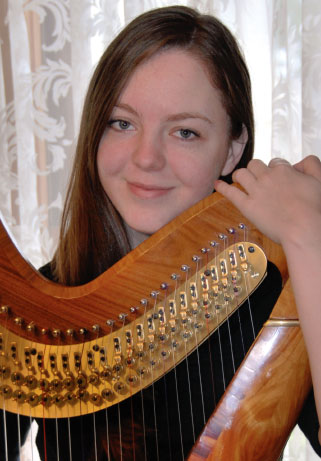
 Join us for Harp music by Lauren Eklund!
Friday, March 23, 2012
3-3:30 p.m.
Collins Library Reading Room
Join us for Harp music by Lauren Eklund!
Friday, March 23, 2012
3-3:30 p.m.
Collins Library Reading Room
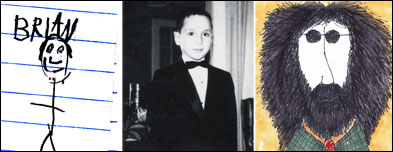
Brian Doyle self-portrait and photo
Brian Doyle, Author
Reading & Book Signing
Wednesday, March 21, 2012
6:30-8 p.m.
Collins Library, Room 020
Brian Doyle edits Portland Magazine at the University of Portland, in Oregon – “the best spiritual magazine in the country,” according to author Annie Dillard, obviously a woman of surpassing discernment. Doyle is the author of twelve books: six collections of essays, two nonfiction books (The Grail, about a year in an Oregon vineyard, and The Wet Engine, about hearts), two collections of “proems,” the short story collection Bin Laden’s Bald Spot, and the sprawling Oregon novel Mink River. Doyle’s books have five times been finalists for the Oregon Book Award, and his essays have appeared in The Atlantic Monthly, Harper’s, Orion, The American Scholar, and in newspapers and magazines around the world. His essays have also been reprinted in the annual Best American Essays, Best American Science & Nature Writing, and Best American Spiritual Writing anthologies. Among various honors for his work is a Catholic Book Award, two Pushcart Prizes, and, mysteriously, a 2008 Award in Literature from the American Academy of Arts and Letters, this last particularly amazing because previous recipients include Saul Bellow, Kurt Vonnegut, Flannery O’Connor, and Mary Oliver, and wouldn’t that be a great dinner table, you know?
His greatest accomplishments are that a riveting woman said yup when he mumbled a marriage proposal, that the Coherent Mercy then sent them three lanky snotty sneery testy sweet brilliant nutty muttering children in skin boats from the sea of the stars, and that he once made the all-star team in a Boston men’s basketball league that was a really tough league, guys drove the lane in that league they lost fingers, man, one time a guy drove to the basket and got hit so hard his right arm fell off but he was lefty and hit both free throws, so there you go.
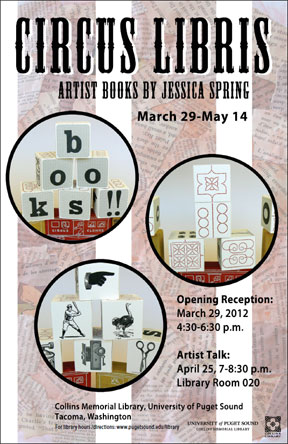 Exhibit open: March 29–May 14
Opening Reception: March 29, 4:30–6:30 p.m.
Artist Talk: April 25, 7–8:30 p.m., Library Room 020
Using an array of old-fangled technologies from papermaking to letterpress printing, Jessica Spring, the proprietor of Springtide Press tames words and images to delight the reader. Small finely-crafted editions consider historical topics and popular culture from a unique perspective, expanding the library’s tent with new-fashioned books. Sponsored in part by the Tacoma Arts Commission.
Ms. Spring was recently named the winner of the fourth annual Foundation of Art Award given by the Greater Tacoma Community Foundation. Spring has exhibited in many local and regional gallery shows, collaborated with other artists, found ed the letterpress/book Wayzgoose event at Kings’ Bookstore. She has an MFA from Columbia College Chicago Center for Book & Paper and teaches book arts at Pacific Lutheran University. Her books are part of many collections including the British Library, Northwestern, University of Washington, Yale, the Ringling School of Art & Design, and the Collins Memorial Library.
Funding from the Tacoma Arts Commission.
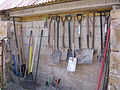
Spitfire at en.wikipedia CC-BY-SA-3.0
Humans are tool users; indeed, it has been argued that our use of tools is a part of what makes us human. However, it’s been found that a wide variety of primates, crows (both New Caledonian and the kind we see here) and as well as other animals use tools. And why wouldn’t they, given how much a good tool improves a job?
So while we can’t console ourselves that tools make us special, we can console ourselves that it makes us faster and more efficient.
With that enticement, check out our New Tools and Widgets page, where we’ve listed information about a wide variety of our tools. Check back now and again as we’ll add new tools that we find particularly useful, too.
Tools profiled include:
Have suggestions for a tool you’d love? Let us know in the comments or via Collins is Listening!
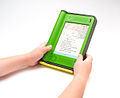
By Design Continuum ($100 Laptop Website) CC-BY-2.5
Have you noticed that Collins Library seems to have a lot more e-books this year? That’s because, well, we do! We’re participating in a great project with all the Orbis Cascade libraries that lets us pool our resources and share e-books from EBL. Collins Library has a lot of other providers of e-books, too, so you’ll see e-books on a wide variety of topics popping up as available at Puget Sound. No matter where the e-book comes from, you’ll be able to discover it in Puget Sound WorldCat or Collins Catalog and access it from a link in the catalog record.
Most of our e-books are usable on the web, the simplest option. But many are also downloadable using Adobe Digital Editions, a free e-reader application. This is a great solution if you’re interested in reading on a desktop or laptop. If you’re using an iPad, e-reader or other mobile device, you can find all kinds of solutions on our e-books resource page, too.
The e-reader and mobile device landscape is changing all the time, so if you notice something different, have a question, or have a tip, please let us know! We’d love to help and learn with you.
To find everything you’d want to know, and, we hope, even more, check out our e-books resources page!
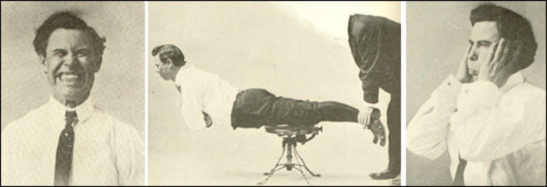 This is a slim little book (Christian Health Science [Flynn Vital Center System of Health Culture] vs. Christian Science“, Call no. RA776 .F65) by W. Earl Flynn, copyright 1907, which was written to instruct the reader on living a long and healthful life. It’s certainly an interesting primary source for early 20th century health trends, but it’s also kind of a hoot to see the photos of physical culture exercises, performed in laced leather shoes, knee breeches, and a tie. Yes, a tie. A sports tie.
Enjoy!
This is a slim little book (Christian Health Science [Flynn Vital Center System of Health Culture] vs. Christian Science“, Call no. RA776 .F65) by W. Earl Flynn, copyright 1907, which was written to instruct the reader on living a long and healthful life. It’s certainly an interesting primary source for early 20th century health trends, but it’s also kind of a hoot to see the photos of physical culture exercises, performed in laced leather shoes, knee breeches, and a tie. Yes, a tie. A sports tie.
Enjoy!
-Rebecca Kuglitsch
 Our new Stereogranimator site (which was created by NYPL Labs and allows you to turn historic stereographs from the Library’s collections into animated GIFs or 3-D images) has gotten tons and tons of attention (as well as tens of thousands of hits), so we thought we’d use it for this week’s Caturday! Check out this amazing dancing cat, originally photographed in September 1918. The original image is in our Robert N. Dennis collection of stereoscopic views. How cool is it to breathe new life into these old photos? Gotta love it.
 In solidarity with writing centers in Germany, Puget Sound’s Center for Writing, Learning, and Teaching (CWLT) will be one of two universities from the US participating in the Long Night Against Procrastination, on March 1.
The Long Night event is designed to help confront those writing tasks we have been procrastinating: papers, grant proposals, homework, and more (we all know what our own specifics are). This event began in Germany in 2009.
At the CWLT, the celebration launches at 3:00 p.m. (German midnight) with German treats, public declarations of non-procrastination, and live interaction with writing centers in Germany. From 4:00 p.m.-midnight, they will be holding regularly scheduled tutoring appointments and writing conferences, and also have special space set aside for those who want uninterrupted time to write quietly, eat some snacks, and stop procrastinating!
 The Animated Film
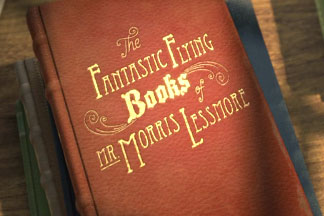
Inspired by Hurricane Katrina, Buster Keaton, The Wizard of Oz, and a love for books, “Morris Lessmore” is a story of people who devote their lives to books and books who return the favor. Watch the oscar winning film Fantastic Flying Books of Mr. Morris Lessmore, a poignant, humorous allegory about the curative powers of story.
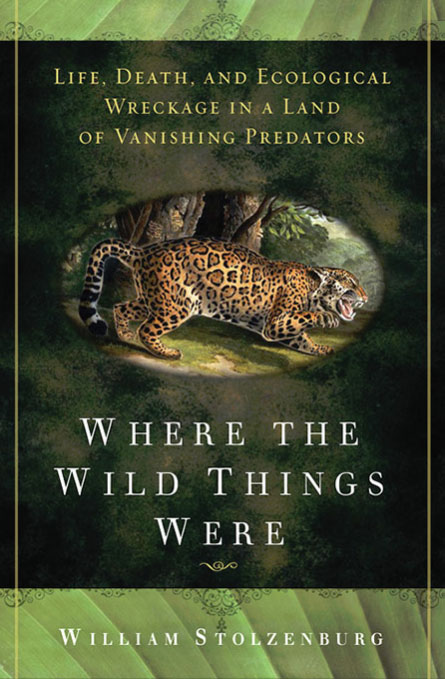 Did you know that a lack of danger is hazardous to the world? It’s true, according to this intriguing and informative book found in the stacks called Where the Wild Things Were: Life, Death, and Ecological Wreckage in a Land of Vanishing Predators. Located on the fourth floor of our library in the stacks at QL758 .S746 2008, this gem offers a provocative new look at the world’s top predators, and the environmental consequences triggered by their disappearance as a result of the superpredators we call humans.
Read about the cougars that leave Zion, a national park in Utah with increased human activity, resulting in thriving mule deer that over forage the land. Or the Shenandoah Mountains in Virginia, where fencing deer out caused a population boom in squirrels, small mammals, and disappearing song birds. In Fontanelle Forest near Omaha, an over-protected forest lacks tree seedlings, birds and butterflies, but thrives in poisonous plants. And no more berries means no more bears. But don’t worry, you’ll also read about some of the wonderful ecological recoveries, lighting some of conservation’s brightest beacons of hope. If you seldom think about disappearing predators, this will give you a world of reason to think again.
***
Have you found an intriquing item in our stacks that you want to share with other library users? Then just fill out this Found in the Stacks form and we will consider posting in on the Inside Collins blog and on our web page.
– Jeanne Young