How to Judge a Zine by its Cover – And Other Things I Learned from Metadata. By Ada Smith

As I wrap up the Library as Collaboratory course and reflect on what I learned, I am amazed at the stark contrast from what I expected when I signed up for this course. All it took for me to add this course to my shopping cart was that the quarter credit that fit into my schedule and most importantly it was about libraries in someway. When I found out that the course was actually about digital humanities and how the liberal arts could be used in a work setting, I was all the more ecstatic. As a college senior I was looking for any and all opportunities on how I could use my degree, and in this age of rapid fire technological growth, becoming competent in anything digital seemed to be a win win.

The course was set up so that each person in the class would be working in small groups with a librarian on a project that incorporated the digital humanities. We would be in charge of project design, managing our own timeline, and communicating with the other group members and the librarian to get the project done. By a grab-bag choice, I worked on the zine metadata project. I knew almost nothing about metadata and only cursory information about zines, so I was guaranteed to learn something from this project.

Metadata is what makes the four stories of our library searchable with the single click of a button. According to Merriam-Webster, metadata has the titillating definition of ‘data that describes other data.’ For the library, this means any information they have logged about a specific item, such as a book or a magazine, in the collection. This is all searchable data, and it is what pops up when you are looking for a specific item in the library using a computer.

I have worked with metadata for many years now; it was a key part of how I found resources for references for my countless research papers and, well, anything in the library. However, I had never put any thought at all into how those small paragraphs under book titles with my searched phrases highlighted in yellow popped up. I might have thought at one point that they were pulled from the abstracts of books, or that some combination of publisher, author, and librarian compiled the list, or even that they were computer generated (I’m not sure how this would have worked, but that’s kind of the point, isn’t it?).

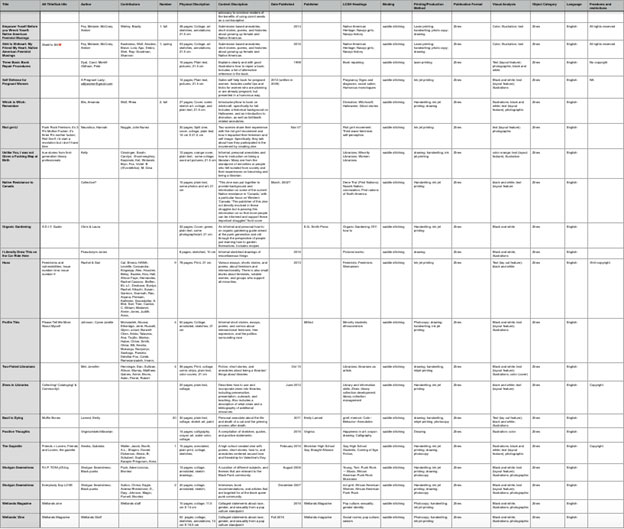
When I was tasked with creating metadata for the zines, I thought that I would just be summarizing the content and listing important data such as title and author. This is what I actually ended up doing:
zine1

Creating metadata is actually a very specific process; for many of the columns you see I had to use controlled vocabulary, which meant that I could only use words from a list. For example, under ‘binding’ I couldn’t just put ‘stapled,’ I had to put ‘saddle stitching.’ This may all seem entirely too bureaucratic and finicky to be of any actual use, but this is all for a purpose. Remember; all of this information is going to be searchable soon. It needs to make sense, and because metadata is created by many different people all the time, there needs to be some standards for what is put in when and where to make sure utter chaos does not reign.

Of course, the format of a zine doesn’t always lend itself to easy metadata. Zine as a genre continually defy defining. The only requirements for a zine being categorized as such is that it needs to have a small publication, and they are generally the size of a regular sheet of printer paper folded in quarters. However, even these loose definitions can be and are bent, and mostly if a creator claims that what they published is a zine, then that is what it is. There are no regulations to include a copyright nor the name of the author. Often a single zine can cover many different genres and topic within the span of only a dozen or so pages.

As maddening as that all was, though, it was also an integral part to what makes zines so important. They are often written by people or groups of people who feel outcast or marginalized by society. They are the results of people struggling to make themselves heard on a platform which they control and which can’t be controlled by anyone else. These little pamphlets hold some of the most raw and honest accounts of what it is like to be human that I’ve ever read, and it has been an honor to read them.

By Ada Smith

Posted in Arts/Humanities, Social Sciences & Science | Leave a comment

Hidden Figures

hiddenfiguresThe phenomenal true story of the black female mathematicians at NASA at the leading edge of the feminist and civil rights movement, whose calculations helped fuel some of America’s greatest achievements in space.  A powerful, revelatory contribution that is as essential to our understanding of race, discrimination, and achievement in modern America as Between the World and Me or The Immortal Life of Henrietta Lacks.

Soon to be a major motion picture starring Taraji P. Henson, Octavia Spencer, Janelle Monae, Kirsten Dunst, and Kevin Costner.

Check it out in the Popular Ready Collection today!

Posted in Popular Reading Collection | Leave a comment

From the Archives & Special Collections: Ch-Ch-Changes

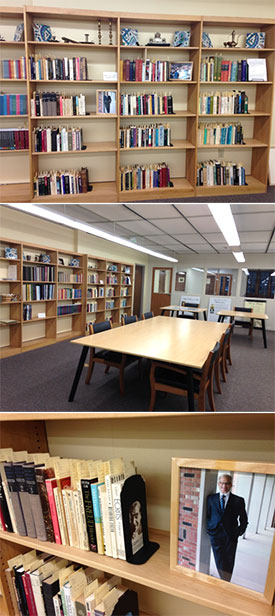
archives-changesGood news! For those of you who haven’t already visited the Archives & Special Collections this year, we got a makeover! Walls have been added, windows, doors, the whole shebang… but it doesn’t stop there! We just recently received our new reading room furniture! Spacious tables and comfy chairs brought to you in order to enhance your archival experience. But wait, there’s more! In the reading room you will find a new collection as well!

Our former President, Ronald R. Thomas, has donated some of his personal library to the Archives & Special Collections. This collection focuses on what RonThom calls “’the long nineteenth century,’ the period stretching from the Victorian Age through Modernity.” A period of big ideas, RonThom describes how these pieces of literature have peaked his curiosity, shaped his thoughts regarding life and literature, and informed his scholarly work. “Literature is everything,” he says, referring to this collection as the “X-ray of the heart of my collection. But there is always so much more to see.” So please come check it out and see what you can find!

The Archives & Special Collections is open on Tuesdays, Wednesdays, and Thursdays from 12:00-3:00 p.m. or by appointment.

By Monica Patterson

Posted in From the Archives | Leave a comment

Food for Fines! November 28th – December 16th

FoodforFinesNovember 28th – December 16th

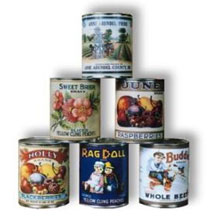
This fall, Collins Memorial Library and the Emergency Food Network of Tacoma are co-sponsoring Food for Fines. Pay off your library fines with food instead of cash, November 28th – December 16th. Donate to a worthy cause AND clean up your library debt at the same time.

Bring in 1 can of food and we will waive $1.00 of your library fines (for returned items). That’s right! $1 per can! No limit!

Welcomed Items:

  • Peanut Butter
  • Canned meats
  • Canned dinners
  • Canned vegetable & fruits
  • Dry beans & pastas
  • Stuffing mix
  • Bring cans to the Circulation Desk on the main floor of the library.
  • 4 ramen noodle packs = $1.00 of fines.
  • One – 6 ounce can or larger = $1.00 of fines. (Unlimited waived)
  • Canned food accepted for fines on returned items only, not for replacement fees of lost items.
  • Only non-perishable, un-dented, and labeled cans will be accepted.
    • Please, no jars/glass containers.
    • Additional donations are welcome. Thank you.
  • All canned food will be donated to the Emergency Food Network.


Posted in Announcements | Leave a comment

From the Archives & Special Collections: Jellied Prunes

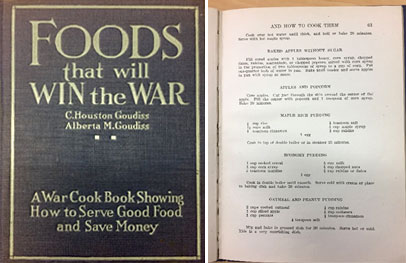
callout_foodswinwarIt is almost Thanksgiving which means food, a lot of great food. Recipes have been perfected, passed down year from year, and everyone has their favorites. It would be safe to say, though, that split pea pancakes, jellied prunes, and fish loaf are not on anyone’s menu. If you do wish to make such dishes, however, there is an interesting cook book, Foods that will Win the War, that you can read in the Archives & Special Collections. There are many recipes for all kinds of foods. It also gives good suggestions for substitutes of grain, meat, and sugar so it really caters to all pallets. One recipe that would be fun to try is the apples and popcorn (pictured below).

The Archives & Special Collections is open on Tuesdays, Wednesdays, and Thursdays from 12:00-3:00 p.m. or by appointment.

By Sierra Scott

Posted in From the Archives | Leave a comment

Library 24/7 Hours Are Dec 4-6 and 11-15!

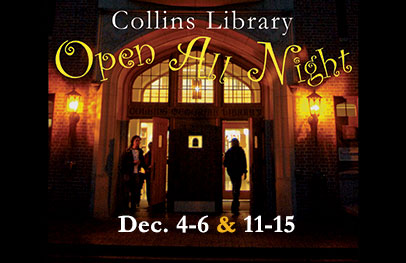
callout_24_7Collins Library wants you prepared for Mid-terms and Finals Week!

The library hours during that period will be:


Dec 4 – 6 Sun – Tues 9 a.m. – Open 24 hours
Dec 7 Wed Closing at 2 a.m.
Dec 8 – 9 Thur – Fri 7:30 a.m. – 2 a.m.
Dec 10 Sat 9 a.m. – 2 a.m.
Dec 11 – 15 Sun – Thur 9 a.m. – Open 24 Hours
Dec 16 Fri Closing at 6 p.m.
Posted in Announcements | Leave a comment

An interview with Braith Birchhall, Serials Assistant in Resource Management Services

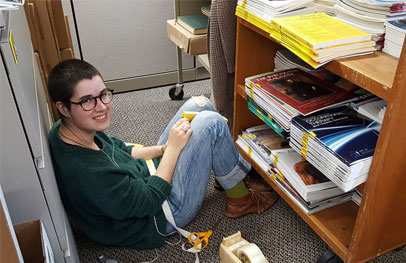
braith1Braith Birchhall works in Resource Management Services as a Serials Assistant. This position assists the Electronic Resources & Serials Specialist with the maintenance of our journals collection both print and electronic.

How would you describe your job?
I am a serials assistant in RMS. I work with periodicals, processing new ones, shelving, recording use, pulling periodicals for binding, re-shelving periodicals after binding, and helping the occasional lost soul navigate the twists and turns of my basement home. I also sometimes do small side projects.

What do you like best about working in Collins Library?
I am lucky to get to work with some really wonderful people. My job is a wonderful balance of sitting and doing computer stuff, and walking around doing shelving stuff. It’s something that I feel competent at when I’m fecallout_braitheling incompetent in everything else. It’s calming and steady and makes me feel productive. It is also really nice to be able to take time off or shift my hours around when I have a lot going on school work wise.

What’s your favorite childhood book and why?
I’m really not a good favorites person, but one of my favorite books as a child (and still one of my favorites now) was The Rabbits’ Revenge by Kurt Wiese, which is about a group of rabbits banding together with a bunch of other creatures to construct a rather complicated plot to prevent old man Shivers from making them into a rabbit-skin suit. I also really love the Bunny Planet books by Rosemary Wells. I still get my mum to read them to me sometimes when I’m really stressed out.


Posted in Spotlight on Library Student Employees | Leave a comment

Diversity and Inclusion Resources

extra1Interested in news and information that offers a perspective other than that provided by the mainstream media.  Checkout Alt-PressWatch or Ethnic NewsWatch for access to current and historical publications from independent, ethnic and minority presses.

Alt-PressWatch
Showcases unique, independent voices, from many respected and cited grassroots newspapers, magazines, and journals.  All of these varied alternative and independent presses are presented in 100% full text, allowing researchers total access to both regional and metropolitan perspectives on local, national, and international issues. Providing an alternative to corporate extra2controlled media, the Alt-Press Watch database presents big stories from small sources.

Ethnic NewsWatch
Covers 1990 to present and includes newspapers, magazines, and journals of the ethnic and minority press, providing researchers access to often overlooked perspectives.  The publications offer both national and regional coverage and is devoted to presenting multi-ethnic and multi-cultural publications in one resource.

Posted in Diversity and Inclusion Resources | Leave a comment

Love. Loss. War. Fate.

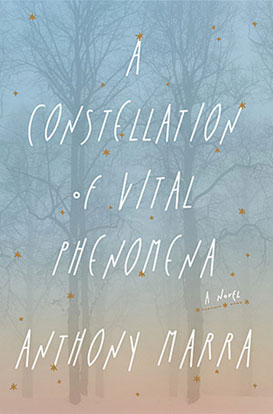
vitalphenomenaAnthony Marra whisks his readers into a riveting tale of a hunted child who was orphaned when Russian soldiers captured her family and left her home in flames. Discovered in the woods days later by a lifelong neighbor with nothing more than a blue suitcase, Havaa is haunted by flames when she closes her eyes, and Akhmed will protect her alongside Sonja, the only remaining doctor in an abandoned hospital.

Discover life’s beautiful and heart wrenching twists of fate with A Constellation of Vital Phenomena, and witness the revelation of an intricate pattern of connections that weaves together the pasts of these three unlikely companions and unexpectedly decides their fate.

Check out new and capturing tales in the Popular Reading Collection today!

Posted in Popular Reading Collection | Leave a comment

From the Archives and Special Collections : Animals at Play

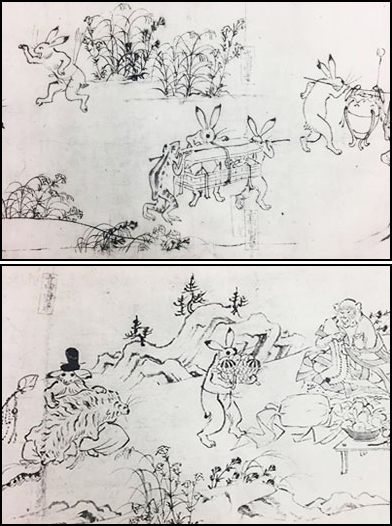
animals-rabbitsAt this time in November, when all the animals are starting to disappear into their warm burrows or nests for winter, it’s nice to remember spring and summer when they were all running around in our backyards. This book, a compilation of four scrolls called the Chōjū-giga or the “Scrolls of Frolicking Animals” show scenes of playing animals such as frogs, rabbits, cats, and even some spiffily dressed monkeys. These scrolls, attributed to Toba Sōjō, can be found and perused at the Archives & Special Collections if you just miss all those cute little creatures running around in this cold season. You can also find out more information about this rare book on Primo!

The Archives & Special Collections is open Tuesdays, Wednesdays, and Thursdays from 12:00-3:00 p.m. or by appointment.

Posted in From the Archives | Leave a comment