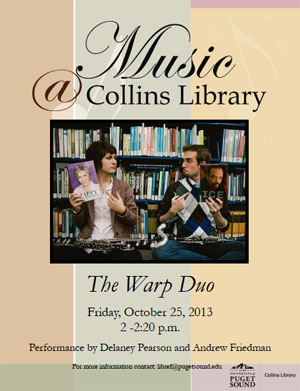
 Join us for our first music in the library series of the academic year!
Friday, Oct. 25, 2013
2-2:20 p.m.
Collins Library Reading Room
Featuring The Warp Duo, performed by clarinet musicians Delaney Pearson and Andrew Friedman.
Join us for our first music in the library series of the academic year!
Friday, Oct. 25, 2013
2-2:20 p.m.
Collins Library Reading Room
Featuring The Warp Duo, performed by clarinet musicians Delaney Pearson and Andrew Friedman.
 The Library acquired a new streaming audio service called Music Online Listening.
 What do these titles have in common? They are the top three most widely checked out books from our Popular Reading Collection! Come visit our collection for a pick of your own.
First Place
Squirrel Seeks Chipmunk: a Modest Bestiary by David Sedaris, illustrations by
Ian Falconer
Second Place
Sherlockian by Graham Moore
Third Place
Bossypants by Tina Fey
Casual Vacancy by J.K. Rowling
Fault in Our Stars by John Green
If You Ask me: (And of Course You Won’t) By Betty White
 Collins Memorial Library
Archives & Special Collections Open House
Don’t miss this special event and the opportunity to contribute to the
125th Anniversary Time Capsule!
October 25, 2013
3:30 – 5 p.m.
Our 125th Anniversary Time Capsule will represent a historic cache of artifacts and information intended to provide a snapshot of the present for future Loggers!
This is your opportunity to pass on lessons and legacies, along with
artifacts from your experience at Puget Sound.
The collection of items will begin September 16th and conclude during Homecoming and Family Weekend, October 25th, at an Open House between 3:30 and 5 p.m. in the Archives & Special Collections, Collins Memorial Library. Items may be dropped off at the library administration office during normal work hours.
 The Puget Sound Time Capsule will be filled with items contributed by:
students
alumni
departments
employees
Please be sure to include the following information on a label with your item:
name
department
campus
phone number
Some suggested items and artifacts for our time capsule:
Photographs
Campus Posters and Flyers
Essays and Exams
Business Cards
Current Puget Sound newspapers and magazines
Logger Clothing
Forecasts of what life will be like 25, 50 or even 75 years from now
Please note, due to the archival nature of a time capsule, we reserve the right to determine if a donated item is inappropriate for the capsule. Thank you.
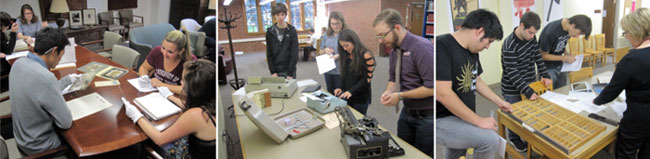 A few weeks ago we had STS 301: Technology and Culture in the Archives & Special Collections for a “History of the Typewriter” day. We are pleased to welcome Alexandria Van Voris, who writes about her experience during that session. Take it away, Alexandria!
Along with other students taking Technology and Culture, a Science, Technology & Society course, I recently had the opportunity to experience hands on research and learning through Collins Library’s Archives & Special Collections. The class participated in a miniature research project looking at many different sources all revolving around the history of the typewriter and its affects on society. This exercise was meant to expose us to the variety of places where one can find information when doing research.
There were many different types of sources available to examine, and each type of source had its own station. We were broken into small groups of 3 or so students, and given a few minutes at each station to explore and examine the artifacts. There were six different stations, and each had new insight to offer into the research process.
Before taking part in this unique and awesome opportunity I had always been a little afraid of using sources that were anything out of the ordinary. If a source was not a secondary source I often steered clear of it. This exercise exposed us to numerous types of sources from primary sources such as University-of-Puget-Sound admissions pamphlets (advertising that tuition was $25 at the time!) to photos taken with classes at Puget Sound. Exploring these brochures provided to us by the University Archives, we found that females were predominately enrolled in classes pertaining to typewriters. This was also supported at the next station’s materials, which had many different books showing inventors belief that they had really helped women out by providing them with typewriters and thus a means for success at secretarial work. While this may seem naïve and elitist nowadays, our research showed that women were indeed in high demand for secretarial work, and many enjoyed the profession while young. Even so, during our research we found that women were generally paid less than men and were often forced to quit their jobs once they got married. Despite this reality the typewriter still was viewed as a tool for enabling woman to become pertinent and desired in the work force.
We also had the opportunity to work with some real life typewriters! These included an IBM Wheelwriter 5 from the 1960s or 1970s as well as a Royal from the early 20th century. Having hands on experience allowed us to fully grasp the progress typewriters made throughout history. The older models of typewriters were substantially harder to use than the new typewriters and this offered us insight into the development of the typewriter. It was really fun to get to type on all of them, and the hands on experience is something not easily forgotten!
Finally one of my favorite things from this activity was getting to use moveable type, a composing stick and type fonts, in order to successfully spell out a provided message. The type fonts were stored in a California Case, which organizes the letters based upon frequency used. While at first this practice seemed fun and foreign, it quickly proved to be increasingly labor intensive and touchy. It was a very meticulous task that left no room for error. Once all of our groups where finished with their sentence, we were told that there would be an opportunity to watch our sentences be printed using a printing press. I attended this event, and had a blast getting to use the printing press and conversing with a student from a local University who works with many different kinds of printing presses for her studies. She showed us all how to apply the ink to the moveable type and press the message onto a sheet of paper. We pressed bookmarks for our whole class, each with the sentences each group had attempted to create. I was lucky enough to have the opportunity to help make quite a few of these bookmarks and it was really fun and eye opening to have the first hand experience of how printing was done, from printing presses where every character in a word has to be individually placed inside the composing stick, and then eventually pressed onto a sheet of paper, to typewriters in which you simply had to push a single key and the letter seemed to just appear, to computers with word programs.
In the end, this activity really did prove to me that there are tons of sources out there that may be a little less conventional, but can greatly increase your knowledge and depth on many different aspects of technology. I don’t believe that materials that are not secondary sources will scare me again! It was a really beneficial and advantageous exercise, which pushed us outside of our secondary source boundaries and comfort levels, but in turn showed us more than we could possibly have learned had we simply stayed within our normal research box. I can say that after this activity I will be breaking out of my box much more often, so I can introduce new and fresh viewpoints and knowledge to my research!
By Alexandria Van Voris
 We welcome Beau Beausoleil to campus. Students from PLU’s Art of the Book class taught by local artist and printer came to Collins Library to meet with Beau and discuss Al-Mutanabbi. Later in the day, Beau shared his perspectives on the exhibit and the project in our Behind the Archives Door series.
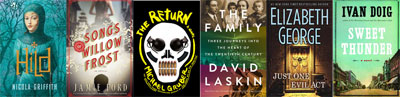 Read some wonderful books by Northwest authors – from this Seattle times Fall list.
Get The Seattle Times on your iPhone for free by visiting http://itunes.com/apps/seattletimesmobile
Copyright (c) 2013 The Seattle Times
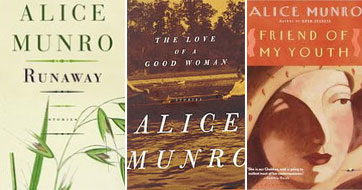 Canadian writer Alice Munro has been awarded the 2013 Nobel Prize in Literature. Calling her “a master of the contemporary short story,” the Swedish Academy announced the award late last week.
Find Munro’s short story collections at Collins Library!
 Open Shutters
October 15, 2013
7:30 p.m.
Beau Beausoleil, poet and book artist, will host a screening and discussion of the movie Open Shutters. This film documents the photography project of five women living together in Damascus. They learn to take photos and present their ‘life maps’ to each other. The women are able to unearth memories buried for 30 years while trying to survive war, sanctions, and dictatorship. In the end, these women from different cities all over Iraq have woven together the threads of their individual lives into a collective fabric.
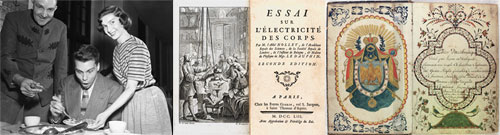 This semester the Archives & Special Collections are experimenting with Tumblr. Our goal is to post an image from the collections every other weekday. Check it out!
http://pugetsoundarchives.tumblr.com/